Article 15 meaning refers to one of the most important constitutional provisions that focuses on equality, fundamental rights, and protection against discrimination. This article plays a crucial role in shaping a fair and inclusive society by clearly stating that no citizen should face discrimination based on religion, race, caste, sex, or place of birth.
Understanding Article 15 meaning is essential for students, competitive exam aspirants, legal learners, and anyone interested in constitutional law and human rights. Beyond its basic definition, this article explains how equality is applied in real life, including special provisions for women, children, and socially disadvantaged groups.
It highlights the balance between equal treatment and affirmative action, making it a frequently discussed topic in legal studies and civic education. Knowing the true scope, explanation, and examples of this article helps readers understand constitutional values, social justice, and individual rights more clearly, making this topic both educational and practically relevant today.
Why This Slang Matters Today
- It’s widely used in serious discussions and casual chats
- It carries social, emotional, and political weight
- Misusing it can cause confusion or unintended offense
- It often signals awareness, equality, or protest
People don’t always use it literally. In many cases, it’s a coded expression rather than a legal reference.
Why People Misunderstand “Article 15”
Most misunderstandings happen because:
- Some think it’s only a law reference
- Others assume it’s a movie title or trend
- Many don’t know it’s used symbolically online
- Context changes its meaning drastically
Without context, article 15 meaning can feel vague or confusing—especially in short messages or captions.
What Does “Article 15” Mean?

Simple Definition
Article 15 is commonly used online to represent equality, fairness, or resistance against discrimination.
In chats, it often means:
- “That’s unfair”
- “This goes against equality”
- “People should be treated the same”
Origin & Evolution
Originally, Article 15 refers to a constitutional principle prohibiting discrimination. Over time, especially after movies, social movements, and viral discussions, it evolved into a shorthand phrase used online.
Evolution path:
- Legal term → social awareness
- Social awareness → pop culture reference
- Pop culture → chat slang
Today, many users type it without explaining, assuming others will “get it.”
TL;DR
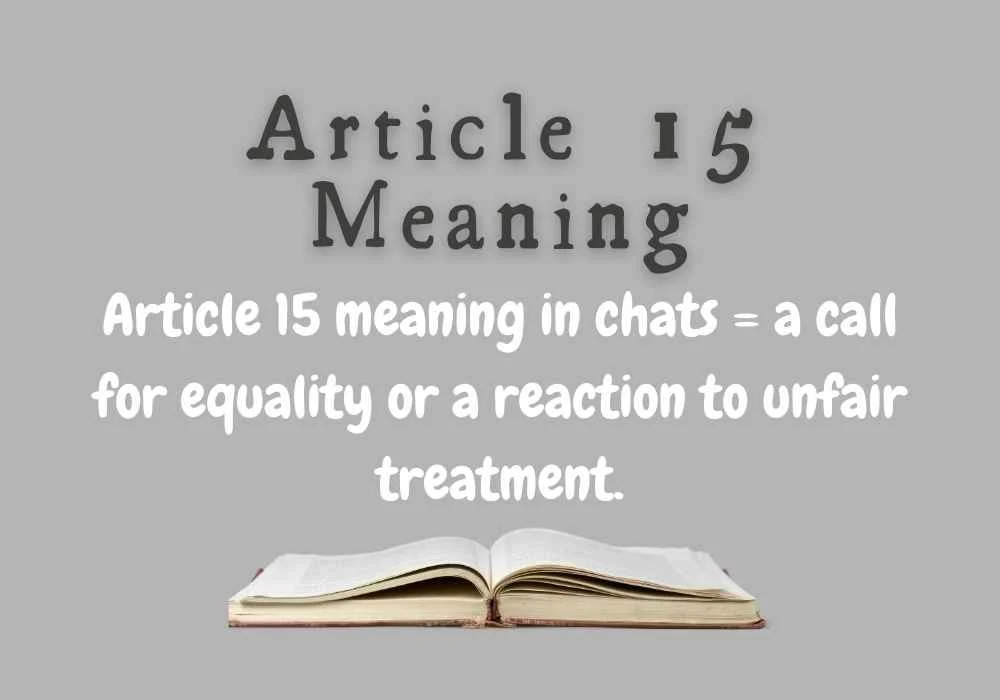
Article 15 meaning in chats = a call for equality or a reaction to unfair treatment.
How to Use “Article 15” Correctly
When to Use It
Use it when:
- Highlighting inequality or bias
- Reacting to unfair rules or behavior
- Supporting equal rights discussions
- Making a serious or ironic point
When to Avoid It
Avoid using it:
- In jokes about serious discrimination
- Without understanding the context
- In professional chats unless relevant
- To mock sensitive issues
Tone & Intent
The tone can be:
- Serious – calling out injustice
- Supportive – standing with someone
- Sarcastic – pointing out hypocrisy
Intent matters more than the words themselves.
Contexts Where “Article 15” Is Used
Texting
Friends often use it casually:
- “That rule only applies to us? Article 15?”
- “Why different treatment? Article 15 bro.”
Social Media
Common in captions and comments:
- “Same rules for everyone. Article 15.”
- “Equality isn’t optional. #Article15”
Discord & Group Chats
Used in debates or moderation talks:
- “Selective banning again? Article 15 moment.”
- “Mods need to remember Article 15.”
Gaming Communities
Gamers use it humorously or critically:
- “Why only our team got nerfed? Article 15 😂”
- “Fair play matters—Article 15 vibes.”
Forums & Comment Sections
Often appears in serious discussions:
- “This policy clearly violates Article 15.”
- “Discrimination dressed as rules—Article 15.”
Real Life Examples
Text Chat Examples
Correct:
- “They promoted him just because of favoritism. Article 15?”
- “Same work, different pay? Article 15 applies.”
Incorrect:
- “I don’t like this movie, Article 15.”
- “My phone battery died. Article 15.”
Social Caption Examples
- “Equality isn’t a trend, it’s a right. Article 15.”
- “Rules should be the same for all. Article 15 meaning understood.”
Funny / Relatable Scenarios
-
When one sibling gets more pocket money
“Parents forgot Article 15 again.” -
When office rules change only for interns
“Corporate Article 15 loading…”
Humor works only when context is clear.
Correct vs Incorrect Usage
| Usage Type | Example | Result |
|---|---|---|
| Correct | “Different treatment for same mistake? Article 15.” | Clear message |
| Incorrect | “I’m bored, Article 15.” | Confusing |
| Correct | “Equality matters here—Article 15.” | Strong point |
| Incorrect | “Article 15 lol random” | Meaning lost |
Common Mistakes & Misunderstandings
- Treating it as a random phrase
- Using it without knowing what it stands for
- Confusing it with movie-only references
- Using it jokingly in sensitive situations
Remember: even when used casually, it carries real-world weight.
Related Slang & Variations
Similar Terms
- Equal rights
- Fair play
- Same rules
- No bias
- Justice served
Platform-Specific Usage
- TikTok: Used in captions and voiceovers about social issues
- X (Twitter): Common in debates and viral threads
- Instagram: Often paired with activism posts
- WhatsApp: Casual shorthand in group discussions
Freshness: 2026 Trends
In 2026, article 15 meaning is trending again due to:
- Short-form videos explaining social concepts
- Meme culture turning legal terms into punchlines
- Youth-driven conversations around fairness
- Increased awareness through online movements
The phrase now blends education, expression, and identity in digital spaces.
FAQs About Article 15 Meaning
1. What does article 15 mean in texting?
It usually means calling out unfair or unequal treatment.
2. Is article 15 a slang word?
It has evolved into informal digital slang, even though it started as a legal term.
3. Can article 15 be used jokingly?
Yes, but only when the context is light and not sensitive.
4. Why do people say article 15 instead of explaining?
It’s a shortcut phrase understood by socially aware users.
5. Is article 15 only used in serious talks?
No, it’s also used casually and humorously online.
6. Does article 15 have different meanings?
The core idea stays the same, but tone changes with context.
7. Is it okay to use article 15 on social media?
Yes, if used correctly and respectfully.
8. Is article 15 related to equality?
Yes, equality is the central idea behind its usage.
9. Can article 15 be misunderstood easily?
Yes, especially when used without context.
10. Should everyone use article 15?
Only if they understand its meaning and impact.
Conclusion
Article 15 meaning in today’s digital world goes far beyond its original definition. It’s now a powerful shorthand for fairness, equality, and calling out bias—used across chats, memes, and online discussions. Knowing how and when to use it helps you communicate clearly and avoid awkward misunderstandings.
Language keeps evolving, and phrases like this prove how online culture reshapes meaning.
👉 Comment your favorite slang!

Joe Root is a passionate relationship writer at wedinglove.com, where he turns real emotions into heartfelt words. With a deep love for weddings, anniversaries, and lifelong bonds, he creates content that helps couples celebrate love in its purest form. His writing is inspired by real stories, genuine connections, and the beauty of lasting relationships.